
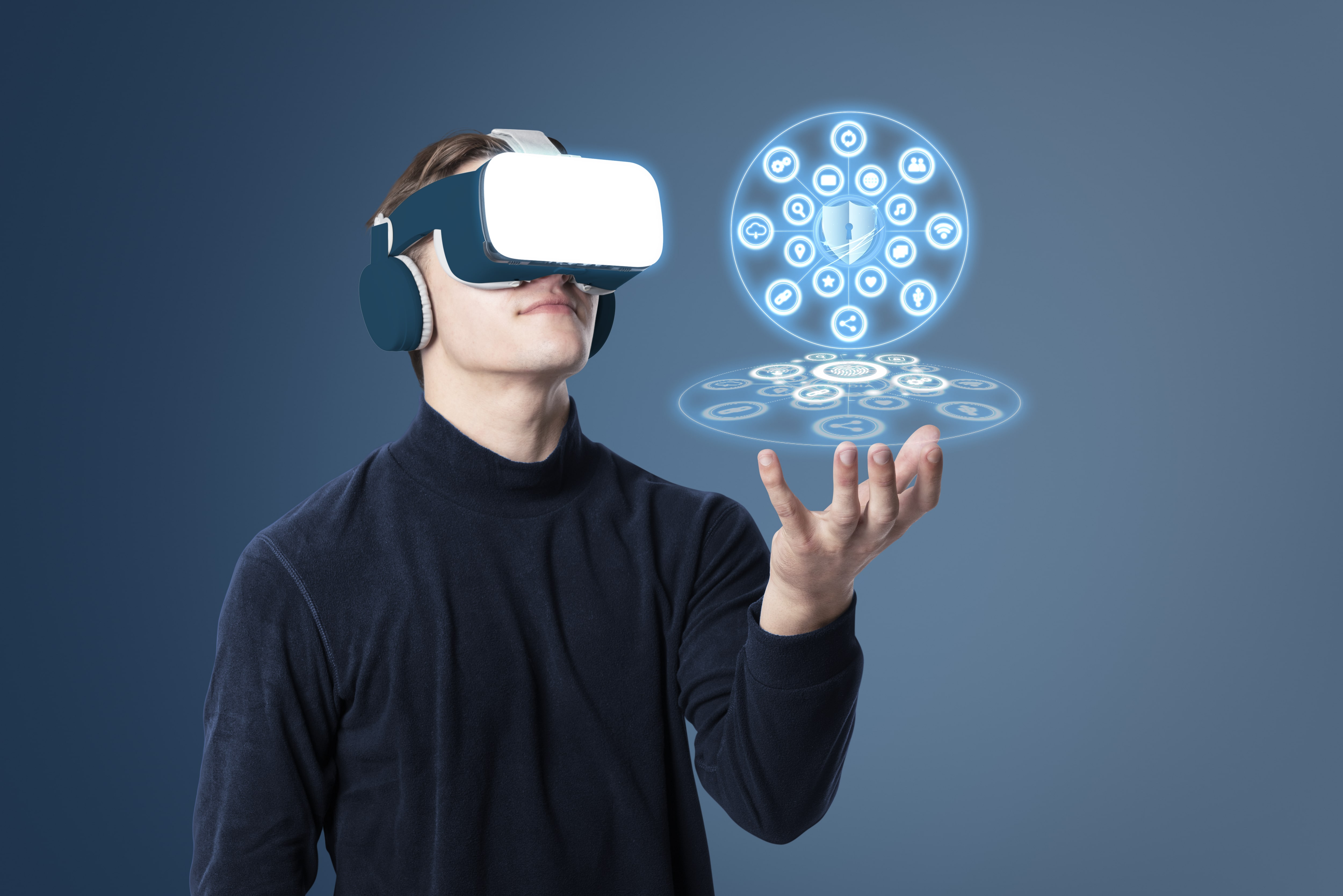
Born at the intersection of imagination and intelligence, today’s AR/VR worlds are not built — they evolve. Game environments that once felt static now breathe, listen, and learn. Artificial Intelligence has quietly become the heartbeat of immersive design — the unseen sculptor shaping dynamic worlds that react to your presence.
The days of predictable NPCs walking into walls are gone. Instead, virtual characters now recognize your rhythm, respond to your actions, and remember your every choice. Games have crossed from pre-programmed entertainment into living simulations — intelligent realms that adapt, evolve, and surprise with every new encounter.
At Nexaura, we don’t just develop AR/VR games; we craft experiences that think. Each project becomes a dialogue between technology and creativity, where AI turns digital landscapes into sentient spaces.
Typography Hierarchy
Always ready to push the limits of imagination, our approach to AR/VR design embraces both aesthetics and analytics. The visual rhythm of immersive interfaces mirrors the way AI processes information — organized, fluid, and purposeful.
Our team understands that immersive experiences are not only seen but felt. Every visual cue, every texture, every interface animation follows a clear hierarchy — guiding the player’s attention through both space and story.
Just as typography defines voice in design, AI defines intent in gameplay. The intelligence beneath the surface transforms mechanics into meaning — turning input into intuition, and code into connection.
Visual Hierarchy
The fusion of AR, VR, and AI has introduced a new creative order. No longer do visuals alone define realism — behavior does.
We observe, measure, and analyze player interactions to the millisecond, crafting worlds that respond organically. Movement, gaze, and gesture become languages of interaction. Every pixel, every reaction, every sound effect exists to maintain flow, focus, and presence.
In this new hierarchy, emotion sits above execution. The user no longer navigates a space; they inhabit it.
Create the Table Lines Here
| Feature | Description | Impact |
|---|---|---|
| Adaptive Difficulty | AI adjusts in real-time based on performance | Keeps players engaged longer |
| Intelligent NPCs | Characters remember interactions | Creates emotional continuity |
| Procedural Worlds | Environments evolve per player choice | Infinite replayability |
| Gesture Recognition | Physical motion becomes gameplay input | Immersion beyond controllers |
| Behavioral Analytics | AI studies player habits | Enables predictive design |
Organize Everything Early and Thoroughly
Every successful immersive project begins with alignment — strategy, story, and system architecture defined together. Before development starts, our analysts, designers, and AI engineers collaborate to balance realism with performance.
Deep planning ensures that emotion and efficiency coexist. Real-time rendering pipelines meet machine learning frameworks in harmony, allowing gameplay to remain smooth even as complexity grows.
Development
Unity Development
Unity remains our go-to platform for merging AI and immersion. With tools like ML-Agents and Barracuda, we teach virtual entities to adapt, think, and evolve. Unity’s modularity allows fast iteration, rapid prototyping, and seamless cross-platform deployment — ensuring that intelligence feels native, not attached.
Unreal Engine Development
When realism matters most, Unreal’s cinematic power takes center stage. The combination of photorealistic rendering and deep reinforcement learning turns virtual environments into believable spaces. Its visual scripting tools empower designers to shape AI-driven narratives without writing a single line of code.
WebXR & Custom Frameworks
For scalable experiences, we turn to the open web. Cloud-based AI models power lightweight AR interactions accessible through browsers. These frameworks trade sheer fidelity for accessibility — perfect for marketing activations, training modules, and scalable simulations.
UX Principal
AI is more than an enhancement — it’s an empathy layer. It studies player behavior and adjusts narrative, tone, and tension dynamically. Our UX approach focuses on merging human psychology with computational intelligence.
From intuitive gesture mapping to adaptive soundscapes, every sensory element serves one goal: presence. We ensure every transition feels natural, every interaction meaningful, and every emotion authentic.
Warmth and comfort hang loosely from the code — each animation, sound, and environment stitched together like digital fabric. Bright interfaces, responsive dialogue, and adaptive motion combine into a sensory symphony that makes the unreal feel human.
The Art of Intelligent Immersion
As hardware becomes smaller and AI becomes smarter, the boundaries between player and platform fade. Edge computing brings cognitive intelligence to headsets, while cloud AI ensures infinite learning potential.
In the near future, your game will no longer just remember you — it will anticipate you. It will sense hesitation, predict curiosity, and personalize every journey.
At Nexaura, we see this not as a challenge, but as a calling — to redefine what interactive storytelling can be when intelligence meets imagination.
The Future Is Responsive
Integrating AI into AR/VR isn’t just a technical evolution — it’s an artistic one. It changes how we design, develop, and dream. The future of gaming lies in spaces that think, adapt, and feel alive.
The question is no longer if your game should use AI, but how human you want it to feel.